Cuenca & Cajas National Park, Ecuador
- jillrsherman
- Oct 28, 2022
- 8 min read

Cuenca is nearly a perfect little city - small and quaint, historic and hip, walkable, livable, and filled with yummy food. Of all the places where I have been in the world, this is a city where I could live in. My father-in-law thought the same a few years ago and nearly made it his annual winter destination. He isn't alone - the secret's out - and Cuenca is becoming a popular retiree destination. It is gorgeous, super affordable, interesting, and has great weather year-round. We even met a young couple planning to live off of their US army pension in Cuenca. In a country where the average monthly wage is $425, you could live like a king on a $1,500 penchant. We saw gorgeous, modern apartments listed for $330/month.
We situated ourselves in the heart of the historic district, a stone's throw from all of the cities architecture and cultural sites. Our first move is always the city's walking tour. As we are homeschooling Dashiell during this trip, we have started a game for him to recall 10 fun facts about the city from the tour. Here are some of the top hits.
There are 53 churches in urban Cuenca. You could go to a different church every Sunday of the year.
The famous blue Cathedral de la Inmaculada was supposed to have 2 more levels. Unfortunately, when they added the bronze statue to the top, it was so heavy that the cathedral started to crack and construction was halted. The blue cathedral is still beautiful and dominates the city nightscape. Climb to the top of the cathedral and you have an awesome view.
The first treatment for malaria was made in Cuenca.
The "Panama Hat" is actually made in Ecuador.
Hortensia Mata - the richest, most famous woman in Cuenca - had 18 children. (My uterus hurts just thinking about this.)
The Incas went back to Peru to get 105,000 men to conquer Cuenca.
Huayna Capac died of small pox. His 2 sons fought for control of Cuenca. 1 executed his brother and massacred the supporting Cañaris in retaliation. The Spaniards came a year later and executed the winning brother with very little resistance.
Ecuador is the third largest flower exporter in the world.
Every time there is a plaza next to a church the plaza has the same name as the church. San Francisco plaza was used for commerce and punishments (executions) since colonial times.
Plants are used as medicines in Ecuador
When kids are stressed their parents take them for "la limpia"
Let's dive into some of our favorite fun facts.
Ecuador is the third largest flower exporter in the world.


The Flower Market at the Cathedral de la Inmaculada Concepción.
National Geographic named Cuenca's flower market one of the best in the world. It is small and sweet, but the setting in the heart of this historical center makes it intimate and special. When Princess Diana got married, she imported $250K in flowers from Ecuador for the wedding. Ecuador is especially proud of their long-stemmed roses which come from the slower growth that occurs at altitude. They smell amazing!
Beside the market is a little window selling a red (sweetened) or transparent drink (unsweetened). It is produced by the nunnery there, where they make water from dozens of flowers and a secret recipe. It is supposed to be a cure-all with medicinal qualities. Apparently, with the nunneries - if you step into one to become a nun, you have one year to change your mind. Afterwards, you never step foot outside one again.


1. The window where the holy, floral water is sold. 2. Dashiell and me enjoying our drinks.
The "Panama Hat" is actually made in Ecuador.
Ecuador is the world's producer of the famous "Panama Hat," so why is it named after another country? These hats are constructed in a unique weaving technique which the Ecuadorians are famous for, especially in Cuenca. These lightweight hats were easy to export and became extremely useful during the hot conditions for the construction of the Panama Canal, where the workers all wore them to protect themselves from the sun. Then, when President Roosevelt went to Panama in 1906 to oversee the development of the Canal, he was photographed wearing this popular hat. This "influencer" moment of the early 1900s was the cause of the misnomer. The hats became wildly popular and were exported by the hundreds of thousands. At one point, they were the main export of Ecuador, inducing tremendous wealth amongst certain families in Cuenca, but also starting slave work and terrible conditions for the actual Panama Hat workers.
Today, this remains a popular industry and artisanal craft, with many more protections for the workers. We visited the workshops and bought ourselves a stylish hat for our trip.
When kids are stressed their parents take them for "la limpia"
La limpia actually means "the cleaning." This is a traditional cleansing process which has been passed down through generations - more like a shaman beridding you of anything terrible going on in your life - known or unknown. Nervous about a test? Feeling stressed or anxious? La limpia is the answer in Cuenca. Most of the people going through the process were pregnant women, babies, and elderly.

Women getting la limpia for their babies.
The process takes place in the busy central market, Mercado 10 de Agosto. We saw that pregnant women and babies were all going through this process. When speaking with local friends that we met in Cuenca, they spoke of going to La Limpia often to get rid of stress before a test or adolescent anxieties. So, naturally, we took the kids for their Limpia.
We hoped to be-rid our 8-year-old of his adolescent, teenagery attitude, help our 2-year-old to express interest in subjects beyond rainbows and Gallo (her imaginary friend who seems to die everyday - “Gallo is dead” and is magically reincarnated as the same green, squishy unicorn) and ensure that Zander is in good health.
For La Limpia, the urban healers follow a precise ritual. The process starts with a bush of bitter plants which are slapped across the whole body to draw out the bad energies.
Then an egg is rubbed around the whole body. After the egg is cracked and the woman reads back what you were cured of. Next, she sprays something on the hands and then rubs some sort of black charcoal on the top of your head, belly, and back, then sprays the hands again.
Zander loved the process and was smiley and “tranquil,” as the healing woman said. It made sense that the egg cracking fortune was "ociado" - which I think translates to "inactive." Perhaps this means that Zander will start crawling soon. He is certainly trying!
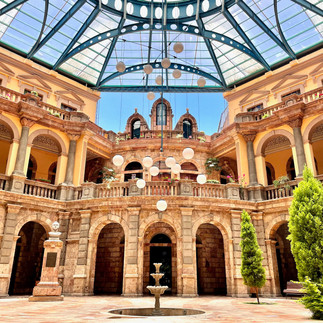
Cuenca is a gorgeous city to wander around and explore.




Pizza - yes, it was so good that it deserves its own section in this post!
We are not exactly foodies, but have been trying to eat as much local food as possible. The one exception is pizza. And in Cuenca, we found the best pizza, which just happened to be at the base of our hostel. We liked it so much that we ate it every day that we were in Cuenca. (Shameful, I know!) As New Yorkers, it has been hard to find good pizza in San Francisco - the Pizza Hacker just doesn't cut it.
Date night - finally!
We also loved our hostel so much that we entrusted them with the kiddos so Jonah and I could have our first date night!! Six weeks of travel and being around them 24/7 can take its toll - man, it was awesome to have some alone time!!! It was our first time leaving Zander behind too.
We treated ourselves to an evening at the hot springs doing their spa circuit together - 1.5 hours of hot water, mud baths, a sauna, and drinks served on a float in the hot pools - divine!

Artisanal Factory
The area around Cuenca is known for more than Panama hats - this is an artisanal hub where traditional garments are created, along with handmade leather goods. We went to a multi-generational home creating the traditional shawls in the "ikat" technique. The woman who demonstrated the process was the 6th generation of her craft, and she said that it will die with her. Just like artisanal crafts around the world, it takes too much time and money to produce everything from scratch. No one has the patience to go through the rigorous, manual process when it is cheaper, faster, and more precise to produce by machine. Sad.

A woman preparing the thread to be dyed and then sown in the ikat traditional style into a shawl.
We saw how this family creates the dyes to color the wool. The dyes were all of natural ingredients. One was from crushed beetles which made a red color. When combined with something else it would change to orange. When combined with another ingredient it would change to pink (we forgot the actual agent which was used, but the pink one is used in makeup and lipstick). Creating the dyes took around 14 days of fermentation.


1. Pottery of the dyes being fermented. 2. Some ingredients used to create a dye. 3. Crushed beetles to create a red color. This is then adjusted to orange and pink with additional agents.
Then they cover the wool threads with local plants to prevent the dye from coloring the yarn. This enabled designs to be created on the finished fabric. How they knew exactly where each white section would be on the finished product to create these uniform designs is totally beyond me - that is a true craft. Lastly they would weave it together on a loom, which alone took 4 days.

The hanging weeds from the tree are used to keep the yarn from absorbing dye. Imogen is tending to Zander while we learn the process.
The finished products were beautiful and could be used as a shawl. The locals use it as a backpack or baby carrier. All over Ecuador you see women in traditional garments and these shawls tied diagonally around their shoulder and back as a backpack to carry goods.
So, after all this hard work, how much does it sell for? $50. Yes, 4 days at the loom and it only sells for $50. Even more sad is how these types of products are no longer of interest as the new generation of youth don’t wear traditional garments anymore. This is where this craft dies. It is worth coming to Ecuador now to see all of the women dressed in their traditional garments throughout the country.
Cajas National Park
Cajas National Park is just 45 minutes from Cuenca - but it is a world of difference. Cuenca sits at an elevation of 8,000 feet. Cajas National Park is at 13,000 feet. This was our highest hike to date. (Luckily, no one has experienced altitude sickness yet. Even baby Zander seems totally immune to the high elevation so far.) The dry, warm climate of Cuenca turns to a misty, mystical terrain in Cajas. The rolling hills, filled with spiky bushes, marshes, and glittering lakes, has been compared to the Scotland Highlands. We hiked through the hills into a strange forest of unique trees which shed like paper, within which we got lost. It felt like we were in the fire swamp of The Princess Bride, without the rodents of unusual size (we hoped!).
We meandered through these hills, past a lake, and straight into a swamp, where we all trekked through water up to our ankles. It was a relief to get back to the car and dry off our feet, although we all enjoyed the trek. (A few weeks later, Dashiell's shoes still stink! If you have advice on how to remove the stink from shoes while traveling, reach out to me!)


Cuenca Zoo
This is the best zoo that I have ever been to. It is more like a trek where you get to see really cool animals than a zoo. You hike up a steep path on a big hill to see bears, monkeys, birds, and reptiles. They all look healthy and happy and there is tons of interesting information. Did you know that dogs have 320 pounds of pressure in their bite, turtles have 1,000 pounds of pressure in their bite, and sharks have 4,000 pounds of pressure. So, what how much pressure do crocodiles have? 5,000 pounds of pressure in their bite! And humans? Only 150 pounds! The "zoo trek" was a lot longer than expected, but it was such an awesome experience and exceeded expectations. Normal zoos will never be the same!

Our wingspan compared to a condor's.
If you are looking for an ideal place to retire, want culture, food, history, and nature at your fingertips - all at a super affordable cost - consider Cuenca.
Next up - meet our car which we call home and have fondly named Bishi!


Comments